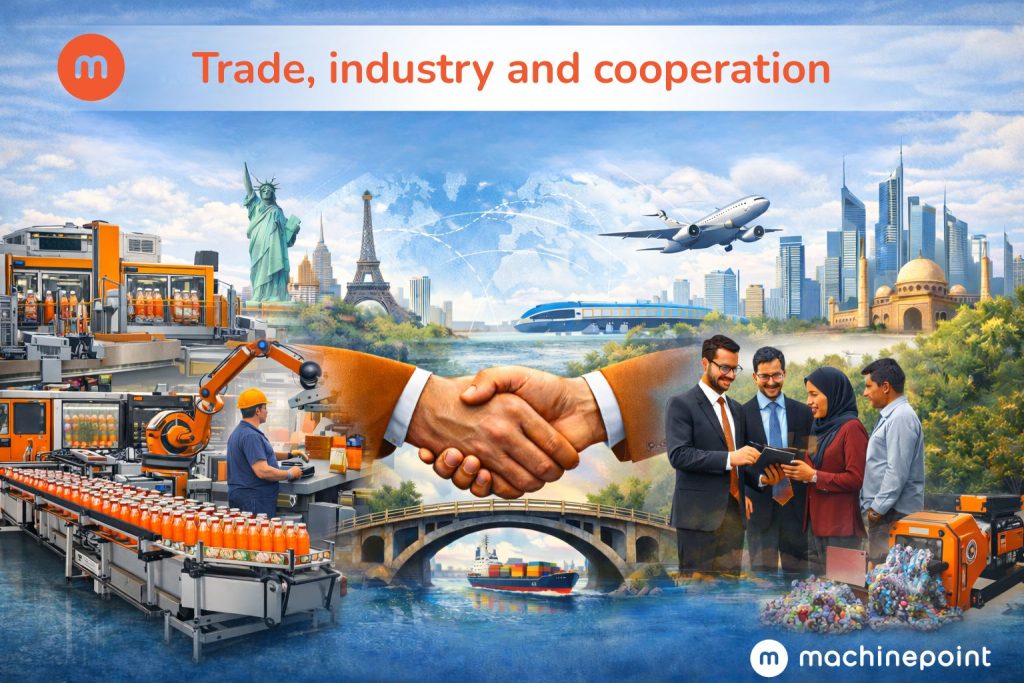
In recent times, we have been witnessing an international landscape in which geopolitical tensions frequently dominate the headlines, yet there is another global dynamic that often goes unnoticed: economic cooperation between companies and countries through international trade.
Companies do not sign peace treaties, but every day they contribute to something that makes peace and stability more possible: trade, job creation, productive investment, and technological collaboration between economies.
At MachinePoint Consultants, we have spent decades connecting industrial companies around the world through projects and transactions involving the purchase and sale of machinery. Throughout our trajectory, we have participated in industrial transactions in more than 120 countries, working with manufacturers from Europe, the Americas, Asia, the Middle East, and Africa.
This experience has allowed us to observe something very clearly: when technology circulates, when companies collaborate, and when markets remain open, lasting bridges are created between economies and societies.
International trade is not only an exchange of goods. It is also a way of building economic relationships that promote stability, development, and shared prosperity.
International trade as a driver of cooperation between economies
Throughout modern history, trade has been one of the main mechanisms for connecting economies and fostering more stable relationships between countries.
When companies from different regions trade, invest, and develop joint industrial projects, they create economic interdependencies that encourage cooperation.
These commercial relationships generate benefits at multiple levels:
- Transfer of knowledge and technology
- Productive investment in new industrial facilities
- Job creation and development of technical capabilities
- Integration into international supply chains
As these relationships strengthen, countries become more economically connected and mutually dependent, which tends to foster more stable and cooperative environments.
Europe: A historical example of how economic cooperation fosters peace
One of the most significant examples of this dynamic is Europe.
After the Second World War, the European continent faced the challenge of rebuilding devastated economies and preventing new conflicts. The response of many countries was to promote economic integration and industrial cooperation.
The creation of the European Coal and Steel Community in the 1950s integrated key industrial sectors among countries that had previously been rivals. This initiative laid the foundations for the integration process that would later give rise to the European Union.
The European experience demonstrated that economic cooperation, trade, and industrial integration can profoundly transform relations between nations.
Today, Europe represents one of the clearest examples of how shared economic development can become a pillar of political and social stability.
Industrial Supply Chains Connect Countries and Companies
In today’s global economy, industrial production rarely occurs within the borders of a single country.
Modern supply chains connect companies from multiple regions around the world. An industrial project may involve:
- Technology developed in Europe
- Components manufactured in Asia
- Automation systems designed in the United States
- Engineering and logistics coordinated internationally
These industrial networks create deep interconnections between economies.
When companies collaborate on industrial projects, exchange knowledge, and participate in global markets, economic relationships are created that go far beyond a simple commercial transaction.
The role of used industrial machinery in global trade
Within the international trade of industrial equipment, the used industrial machinery market plays a fundamental role.
The buying and selling of second-hand machinery allows productive technologies to circulate between different countries and regions, making it possible for more companies to access advanced industrial equipment.
This market contributes to several key processes:
- Global technology transfer: Used machinery allows industrial technologies developed in certain markets to later be used in other countries, accelerating industrial development.
- More accessible industrial investment: Many companies can expand their production capacity by acquiring reliable equipment with a more efficient investment.
- Industrial development in new markets: The circulation of machinery enables new companies and regions to join global production chains.
- Boost to the industrial circular economy: Reusing machinery extends the lifespan of industrial equipment and reduces resource waste.
In this way, the used machinery market contributes not only to economic growth, but also to a broader global distribution of industrial capabilities.
The circular economy as an opportunity for industrial cooperation
The reuse of industrial machinery also aligns with the principles of the circular economy, which promotes more efficient use of resources.
When an industrial machine moves from one factory to another, its operational life can be extended for many years, reducing:
- The consumption of new raw materials
- The energy required to manufacture new equipment
- Industrial waste
This approach not only improves economic efficiency but also encourages more sustainable and collaborative production models.
MachinePoint and the creation of global industrial bridges
For decades, MachinePoint has worked to connect industrial companies from different regions of the world.
We have participated in projects that have enabled:
- European manufacturers to expand their technology into Asia
- Latin American companies to access advanced industrial equipment
- Middle Eastern producers to modernize their plants
- Asian manufacturers to integrate machinery from different markets
Each of these projects represents an economic bridge between companies, knowledge, and markets.
Through these bridges, long-term commercial relationships based on trust and cooperation are created.
Trade, Technology, and Shared Prosperity
Through our experience working with companies in more than 120 countries, we have learned a simple lesson. Trade bridges help build more stable relationships between economies.
When companies exchange technology, develop industrial projects, and participate in global markets, they help generate shared prosperity.
In this sense, international trade, industrial cooperation, and the circulation of technology can become one of the strongest foundations for fostering more stable relationships between countries.
Because, although companies do not sign peace treaties, every industrial project and every economic collaboration contributes to building a more connected, prosperous, and cooperative world.