For years, plastic was synonymous with progress. It revolutionized the packaging industry, automotive manufacturing, medicine, and fast-moving consumer goods thanks to its strength, light weight, and low cost.
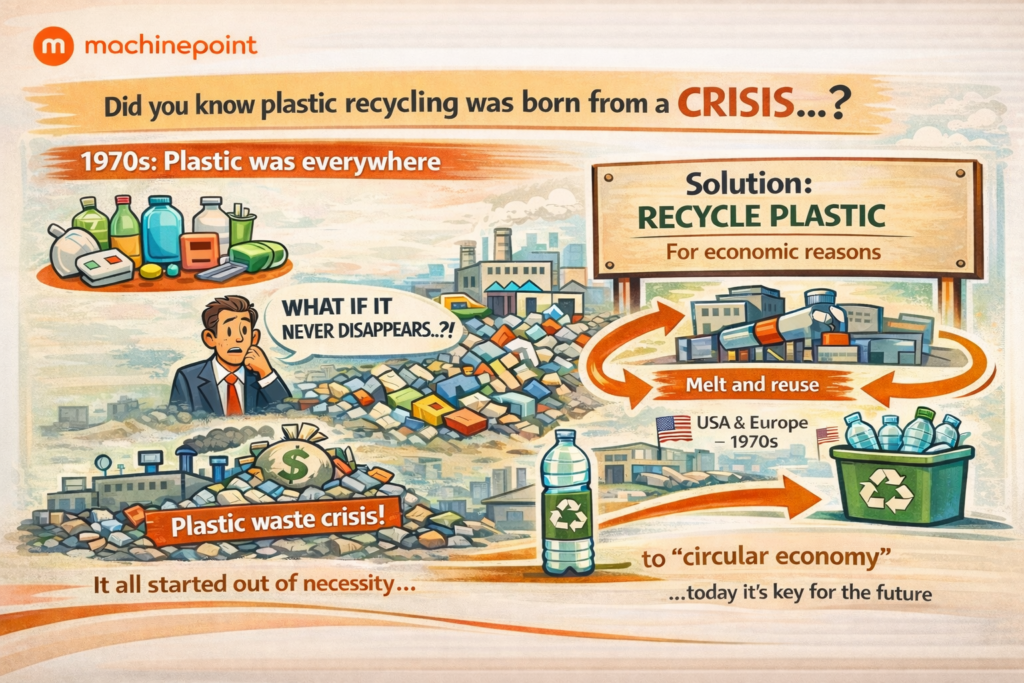
But by the late 1970s, a contradiction became increasingly evident: this virtually indestructible material did not disappear once it became waste.
Landfills were expanding, waste management costs were rising, and at the same time, oil prices were increasing. The industry faced an uncomfortable reality: continuing to produce virgin plastic while tons of waste accumulated was neither sustainable nor economically efficient.
Recycling was not born as an environmental slogan. It was born as an industrial decision.
The first PET recycling lines emerged in this context, initially focused on producing textile fibers and lower technical-demand applications. However, the major turning point came in the 1990s and 2000s, when advances in filtration and decontamination technologies made it possible to manufacture recycled material suitable for food contact applications.
That moment changed the model: a bottle could become another bottle again.
Specialized technology manufacturers such as EREMA, WEIMA, and MACCHI have been an essential part of this technological evolution, developing increasingly efficient systems for shredding, washing, extrusion, and pelletizing.
Today, plastic recycling is a structural pillar of the global industry. Not only due to regulatory requirements or sustainability commitments, but because it has become part of cost strategy and raw material sourcing.
The Strategic value of used machinery in recycling
In this context, technology is key. But so is the way companies access it.
Investing in a complete recycling plant can be significant. For many recyclers and converters, used machinery represents a strategic path to:
- Reduce initial CAPEX
- Shorten start-up timelines
- Access established brands with lower financial risk
- Scale capacity progressively
This is where MachinePoint plays a role.
At MachinePoint, we work with second-hand plastic recycling machinery: complete PET recycling lines, shredding systems, washing equipment, regranulation extruders, and pelletizing systems. Our approach goes beyond buying and selling; we assess the technical condition of the equipment and carry out inspections to ensure it can return to production with full guarantees.
Every recycling project activated with used machinery not only recovers plastic — it also recovers industrial assets that still have productive capacity. This logic is fully aligned with the principles of the circular economy: maximizing the value of existing resources.
Reusing machinery allows new plants to start operating more quickly and enables expanding companies to increase capacity without assuming the full cost of brand-new equipment.
In a sector where margins may depend on resin prices and operational efficiency, optimizing investment in technology can make a decisive difference.
Plastic recycling began as a pragmatic response to an industrial crisis. Today, it is a strategic component of the global production model.
And in this transformation, both the material and the machinery can have a second life.