By César Rodríguez Gabilondo, Founder & CEO of MachinePoint
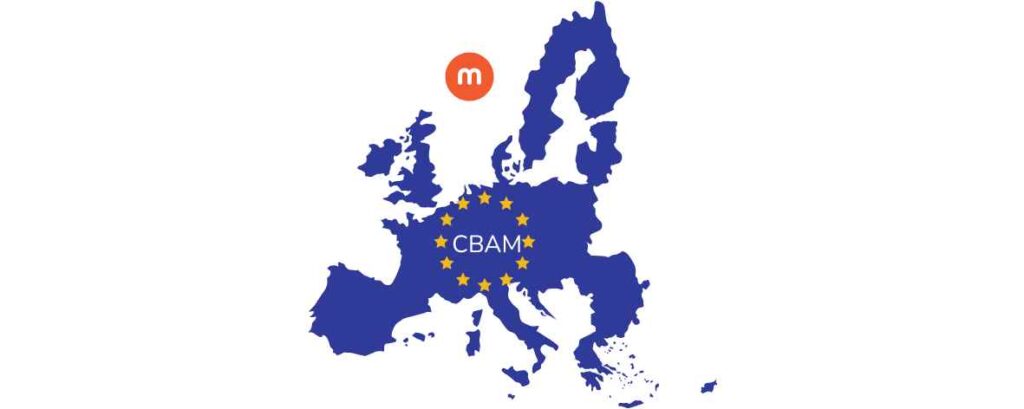
Since January 1st, the Carbon Border Adjustment Mechanism (CBAM) has entered its final phase a milestone many of us have celebrated. For the first time, Europe has decided that decarbonization cannot be confined within its own regulatory borders: if carbon carries a price inside the EU, it should do so for those who want to sell into its market as well.
That decision was necessary. But it is not complete.
Today CBAM covers basic industrial inputs such as steel, aluminum, cement, fertilizers, electricity and hydrogen materials responsible for a significant share of Europe’s industrial emissions. However, it excludes the complex industrial products manufactured from them, including heavy industrial machinery.
As a CEO in a deeply industrial sector, this asymmetry is not just a technical issue. It is a strategic risk.

Competitive asymmetry: Europe pays for carbon, others do not
The European machinery sector is one of the continent’s most relevant industries. According to VDMA figures, it employs around 3 million people in the EU and generates an estimated €870 billion in output. It is export-oriented, technologically sophisticated and built on a long metal-based value chain.
And here lies the inconsistency: the EU requires its manufacturers to internalize the cost of carbon through ETS, energy prices and strict environmental regulations. Many global competitors do not.
But when a finished machine enters Europe, the regulatory differential disappears. There is no equivalent adjustment.
The result is that manufacturing a machine inside the EU is more expensive because it embeds carbon that is priced, while producing it abroad and selling it into Europe avoids that cost.
That is not ecological transition; it is competitive asymmetry.
The Industrial Risk of an Incomplete CBAM
Some industrial associations, including VDMA, have reacted with concern to the idea of extending CBAM to machinery. They warn that it could add complexity, administrative burdens and export challenges.
I understand these concerns. But I deeply disagree with the diagnosis.
The real risk to industry is not a broader and smarter CBAM.
The real risk is an incomplete CBAM that reinforces the competitive advantage of those who produce while emitting more carbon.
If Europe wants its heavy industry to still exist a decade from now, carbon pricing must be reflected across the entire value chain, not just in the inputs.
Bureaucratic complexity or production leakage?
Decarbonizing industrial sectors has never been an exercise in simplicity. The relevant question is not whether an expanded CBAM adds administrative burden, but what we compare it against.
Because the current system has its own costs:
• Europe loses industrial production (downstream)
• It shifts emissions to other countries
• It loses the associated added value
If Europe taxes steel but not the machine, it incentivizes producing the machine elsewhere. And that is exactly what the policy is meant to prevent.
Embedded carbon: The great absentee in the debate
There is an additional element that is almost never mentioned in industrial decarbonization debates: the embedded carbon in existing industrial assets.
A machine embeds tons of steel, aluminum, energy and transport. Manufacturing a new one means re-emitting them. Refurbishing or reusing an existing one does not.
In our experience, extending the useful life of a machine by 10 or 20 years can prevent far more carbon emissions than recycling the materials.
This is real industrial circularity and it does not appear in transition accounting.
CBAM will hurt MachinePoint, but It will benefit european industry
I am not advocating this position for the benefit of our company, but for the benefit of the European industrial machinery sector to which we belong. European used machinery would gain value once CBAM for machinery is implemented. This would benefit storage-based resellers, who would see their inventories appreciate, and European manufacturers, who would see the value of their productive assets increase.
Exports of European used machinery (more expensive) would become harder, and imports of used machinery into Europe would become costlier.
We should not ask for less CBAM, but a better CBAM
An expanded CBAM would not be green protectionism; it would be rule symmetry. And with intelligent design it could incorporate:
• Category-level emission values based on simple parameters
• Default values with the option to prove better performance
• Long transitional periods
• Minimal administrative burden for manufacturers
None of this is utopian. It is regulatory engineering. The difficulty is not technical, it is political will.
Europe does not need to choose between climate and industry
Europe does not have to choose between climate ambition and industrial strength. The narrative that decarbonization requires de-industrialization is wrong. And those who repeat it are, unintentionally, advocating for a scenario in which Europe becomes a buyer of machines and a producer of regulations.
That is not the role Europe has historically played nor the one it needs to occupy in the next industrial revolution. The climate transition will be industrial, or it will not be European.
Today, with CBAM already in force, Europe faces a clear choice: it can allow its climate policy to inadvertently undermine its industrial base, or it can refine CBAM so that climate ambition and industrial competitiveness reinforce one another.
Extending CBAM to industrial machinery carefully, gradually and intelligently, would protect European manufacturers from unfair competition, prevent carbon leakage in complex products, incentivize cleaner production globally and, above all, align climate policy with industrial reality.
The climate transition will be industrial, or it will not be European.
Looking for a more sustainable alternative to buying new machinery? Discover our available machines or request a personalized offer today