Circular plastics production in Europe grew by just 1.2% in 2024. After years of progress, the sector has moved from the regulatory momentum of the pre-pandemic years, through the growth of 2020–2022, to a slowdown that, according to EFE, was already visible in recycling plant closures between 2022 and 2024.
Before 2020: recycling takes off
By the end of the last decade, plastics recycling in Europe was expanding rapidly. According to Plastics Europe, 29.1 million tonnes of plastic waste were collected in 2018: 32.5% went to recycling, 42.6% to incineration and 24.9% to landfill. The trend was clear: between 2006 and 2018, the amount of plastic sent to landfill fell by 44%, while recycling doubled.
Two factors drove investment: the European Strategy for Plastics and China’s ban on waste imports, which forced Europe to recycle more within its own borders. At the time, Plastics Recyclers Europe was already noting that both factors were accelerating new projects across the continent. Even so, recycled material still played a modest role: according to the European Environment Agency (EEA), secondary plastics accounted for 6.9% of EU plastics consumption in 2018.
2020–2022: the circular economy gains ground during the pandemic
The pandemic did not halt the trend. In 2020, according to Plastics Europe, production of post-consumer recycled plastics rose by 12% compared with 2018, and its use increased by 15% to 4.6 million tonnes.
In 2022, Plastics Europe put the recycling rate at 26.9%, and circular plastics already accounted for 13.5% of new products manufactured in Europe, halfway to the industry’s 25% target for 2030.
For many recyclers, these were very good years. In Poland, for example, mechanical recycling grew by 15% to 17% a year between 2019 and 2022, with profit margins exceeding 10% at times.
Since 2023: Europe loses momentum
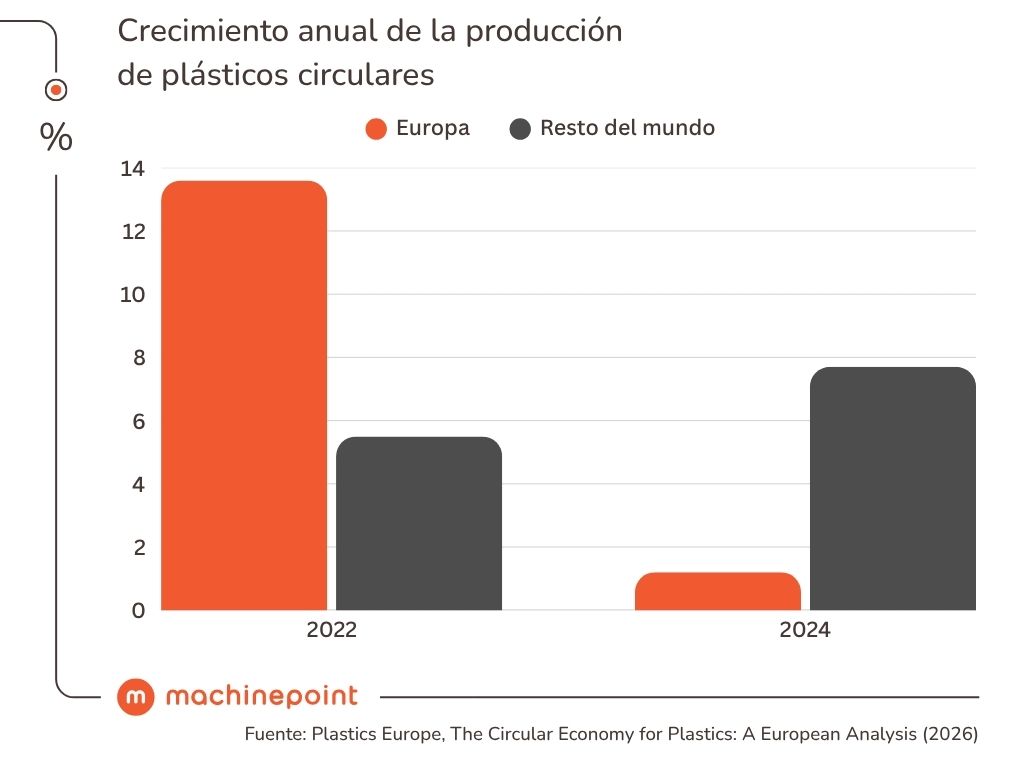
The latest Plastics Europe report, The Circular Economy for Plastics: A European Analysis, based on 2024 data, confirms the shift. Annual growth in European circular production fell from 13.6% in 2022 to 1.2% in 2024, reaching 8.7 million tonnes, or 15.8% of total plastics production.
While Europe is slowing down, the rest of the world is speeding up: globally, growth in circular production rose from 5% to 7.7% over the same period. Demand is also cooling, with annual growth in converters’ demand for circular plastics falling from 16.2% to 4%.
More is being recycled, but most waste remains outside the loop
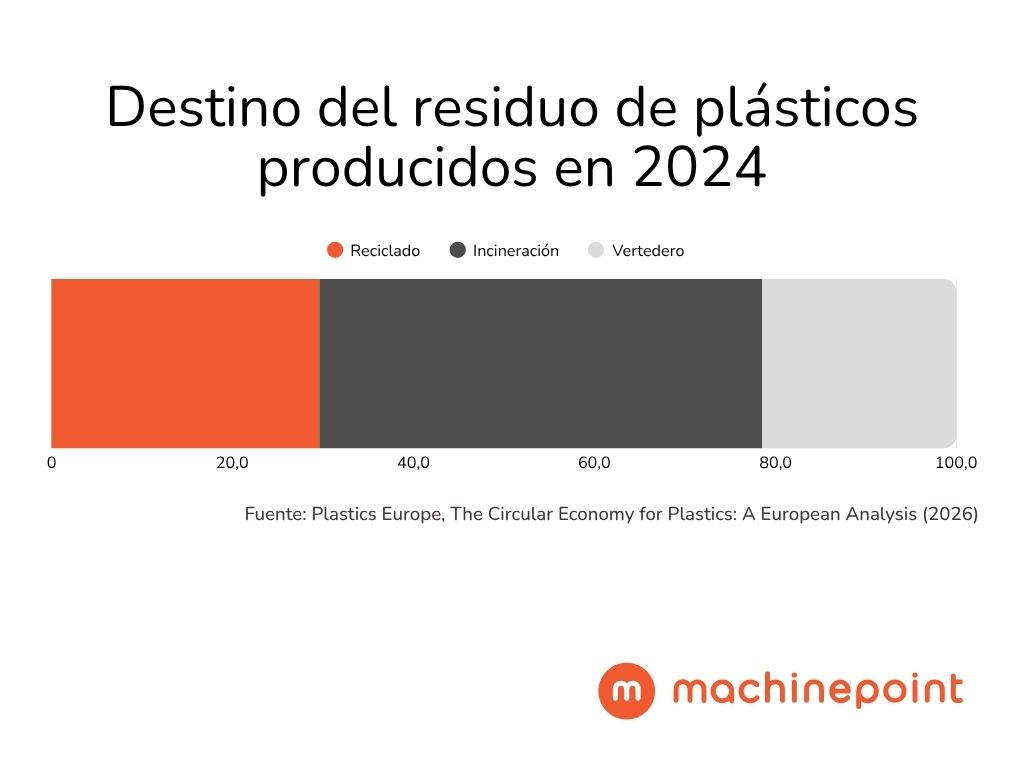
Europe’s recycling rate improved to 29.6%, but most of the plastic waste collected still ends up incinerated (16 million tonnes, or 48.9%) or in landfill (7 million tonnes, or 21.5%). These are secondary raw materials that could reduce dependence on fossil resources, and today they are being lost.
Europe exports waste and imports recycled material
These figures are key for the continent, as they reveal a growing dependence on outside sources. Around 19% of converters’ demand for circular plastics is met by imports, while 12.4% of the waste collected in Europe is recycled outside the continent.
Plastics Europe attributes this to high energy, raw material and emissions costs, and to a lack of fair trading conditions, which are keeping the sector in survival mode and holding back investment in circularity. Its Director General, Virginia Janssens, argues that recycling plastic waste within Europe must be profitable, and that the upcoming Circular Economy Act should make circularity an attractive business model.
Not a collapse, but a shake-out
The case of Poland helps make sense of these figures. An analysis of 61 recyclers between 2021 and 2024, published by Plastics Review, shows that 24 companies grew and 37 declined, with the sector average remaining virtually flat.
The largest plants were not the ones that grew the most. Growth came from mid-sized companies with a clean material stream, guaranteed sales and a clear customer at the end of the chain, while those selling generic regrind lost both volume and margin. The companies that held up best were those that integrated recycling with conversion, for example alongside a film producer, or those that specialised in a single stream, such as PVC from window profiles.
The type of polymer also makes a difference. In 2024, recycling margins stood at around 4.4% for HDPE and PP and 3.5% for LDPE/LLDPE, while PVC, PS/ABS and PET were already in negative territory. And within each material, quality matters more than the label: natural rHDPE from bottles sells above virgin prices, whereas in rPET, when the price gap with virgin material soars, brands cut recycled content to the legal minimum.
Why recycling remains essential
The figures of recent years do not make recycling any less important. On the contrary, they show how much remains to be done. Every tonne of plastic that goes back into the loop is a tonne that does not end up in landfill or an incinerator, and that reduces the need to make new plastic from fossil resources.
Nor is the circular economy just an environmental issue. It is also a matter of autonomy: the more waste is recycled within Europe, the less the industry depends on raw materials and imports from abroad. And it is an opportunity for companies that know how to adapt to an increasingly demanding market.
The circular economy also starts with machinery
Circularity is not limited to materials. The machines that process them can also have a second life. An extrusion line, a blow moulder or a recycling line that is no longer used in one factory can continue producing for years in another. Extending the service life of industrial equipment makes better use of the resources that went into manufacturing it.
Are you thinking about expanding or setting up a recycling line? Tell us what material you process and what product quality you need, and we will help you find the right machine.